The Core Concept: Declining Price, Declining Selection
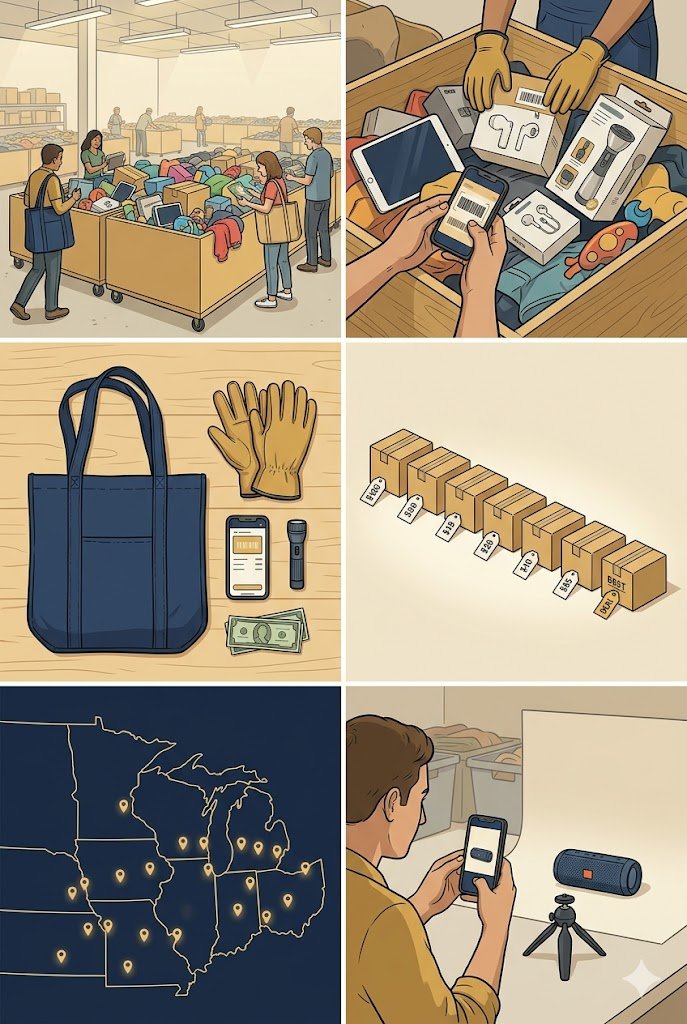
Every bin store operates on a simple inverse relationship: as prices fall, selection falls with them. Day 1 (restock day) has the highest prices and the best selection. Day 7 has the lowest prices and whatever's left. Every shopping decision at a bin store is a bet on where you sit on that curve.
Different stores use different specific price points, but the structure is nearly universal. Here's a typical 7-day cycle and what it means for shoppers.
Day 1 — Restock Day ($8–$12)
The store closes for 12–24 hours before restock day. Staff clears remaining merchandise, cleans bins, and fills every bin fresh from the new truckload. When the doors open, every item costs the same: $8–$12 at most Midwest stores.
Crowd level: Highest of the week. Experienced shoppers and resellers know the schedule and arrive at opening or before. Lines form at busy stores in Columbus, Indianapolis, Milwaukee, and Chicago suburbs.
Best for: Electronics, premium appliances, tools, gaming equipment — high-value items that are worth paying the premium before they're gone. If you're looking for a Dyson or a KitchenAid, restock day is the only reliable option.
The math: At $10/item, you need a $30+ resale value for a 3x return. Plenty of items on restock day clear this bar. The challenge is identifying them fast enough before other shoppers do.
Days 2–3 — Early Decline ($5–$7)
Prices drop to the $5–$7 range. The obvious high-value items from restock day are gone, but plenty of solid merchandise remains. Crowds thin significantly — this is when knowledgeable shoppers who couldn't make restock day get their picks.
Best for: Shoppers who want reasonable prices and adequate selection. Clothing, toys, home goods, and kitchenware all pick more slowly than electronics. Mid-week Day 2–3 often yields great clothing and household finds at prices well below restock day.
The math: At $5/item, you need $15+ for a 3x return. A much larger portion of remaining inventory clears this bar than restock day pricing.
Days 4–5 — Sweet Spot ($3–$4)
The underrated window. Prices are genuinely low, crowds are light, and items that were marginal at $10 or $7 are now clearly compelling at $3. This is the bin store equivalent of a department store's last clearance day — items that survived this long are there because casual shoppers didn't recognize their value.
Best for: Resellers with category knowledge. If you know that a specific tool brand, kitchen gadget, or toy line has strong resale value, Day 4–5 at $3 can yield extraordinary margins. Also excellent for casual shoppers who want low-risk bargain shopping without dollar-day crowds.
The math: At $3/item, anything worth $9 or more on resale is a win. The bar is now low enough to buy speculatively on items you're less certain about.
Day 6 — Dollar Day ($1)
Everything is $1. Crowds return — this time for volume. Resellers fill bags quickly. Regular shoppers grab armloads of items they can use at home. The energy is chaotic but good-natured at well-run stores.
Best for: High-volume buying. Home goods, cleaning supplies, personal care items, children's books, craft supplies, and clothing that you'll use personally regardless of resale value. At $1, the buy threshold is "will I use this?" rather than "is this worth reselling?"
What survives to dollar day: Items that are visually unappealing, missing packaging, appear broken (but may work), or are in categories that most shoppers don't recognize as valuable. Dollar day rewards shoppers who look past surface appearance.
Day 7 — Quarter Day ($0.25)
Not all stores do quarter day. When they do, it's the final few hours before the store closes for restock. Whatever didn't sell at $1 goes for a quarter. Much of what's left is genuinely worthless. But quarter day also yields the occasional overlooked gem that survived an entire week of shoppers who somehow missed it.
The strategy: If a quarter day store is near you and you're passing by anyway, a 15-minute sweep costs almost nothing. Don't make a special trip. Do sweep quickly through the bins before they close.